Mastering Precision with the Ring Gauge
Consistency is the heartbeat of manufacturing. When you produce thousands of cylindrical parts, you must ensure every piece fits perfectly. Consequently, a ring gauge serves as the ultimate standard for verifying external diameters. By using this tool, you ensure your components meet strict engineering specifications every single time.
What is a Ring Gauge?
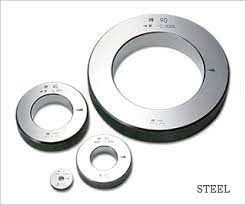
To begin with, a ring gauge is a high-precision measurement tool. Manufacturers typically craft them from thermally stable materials, such as hardened steel or chrome. Furthermore, each gauge features a highly finished internal diameter. As a result, machinists use these tools to check the outside diameter (OD) of pins, shafts, fasteners, and studs with total confidence.
The Power of Go and No-Go Testing
Most quality control teams use ring gauges in pairs. This creates a "limit gauge" system, which works as follows:
-
Go Gauge: First, the part must slide through this gauge smoothly. If it fits, you know the part is not too large.
-
No-Go Gauge: Next, the part should not enter this gauge. If it stays out, the part is not too small.
Therefore, if your component passes both tests, it falls within the acceptable tolerance range. This method is much faster than using a micrometer, especially during high-volume production.
[Image demonstrating a shaft being inspected with a Go ring gauge]
Essential Maintenance Tips
To maintain the accuracy of your ring gauge, you must treat it as a master reference. For instance, always clean the workpiece before testing. This prevents abrasive dust from scratching the gauge surface. Additionally, apply a thin layer of protective oil after use to stop rust. Finally, you should schedule regular calibration to account for natural wear over time.
Why Quality Matters
Ultimately, using a certified ring gauge eliminates guesswork on the shop floor. It protects your business from costly rejects. Moreover, it ensures your customers receive perfect parts every time. Whether you work in aerospace or automotive repair, this tool is your best defense against dimensional errors.
Sub-zero treatment (Cryogenic hardened) - ALLOY STEEL
As master gauge for "0" adjustment
of measuring tools such as bore gauge, inside micrometer,
dial caliper, etc.
Actual Size 0-30mm, Tolerance +/-1.0um
Actual Size 30-50mm, Tolerance +/-1.5um
Actual Size 50-100mm, Tolerance +/-2.0um
Actual Size 100-200mm, Tolerance +/-5.0um
Hardness HV 653-772