Durometer Test Stand
The Challenge of Manual Testing
Durometer Test stand test hardness of materials—rubber, plastics, and elastomers—with a hand-held durometer proves challenging. Often, human error in applying the force or maintaining perpendicularity introduces measurement variability. This inconsistency is a major problem for quality control and material specifications. Therefore, relying only on manual readings can cause unnecessary product rejection or product failure from incorrect material data.
The Precision of a Durometer Test Stand
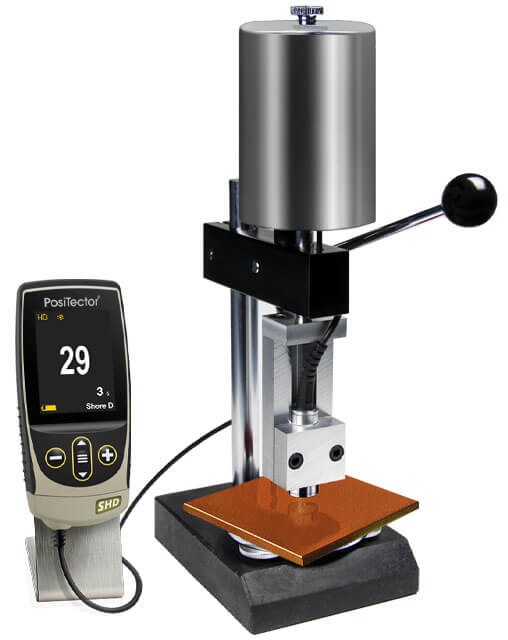
A durometer test stand eliminates these variables. This instrument holds the durometer gauge. It features a precision mechanism that controls both the rate and the amount of force applied to the test sample. Consequently, technicians perform every test under nearly identical, standardized conditions. The stand typically uses a precisely weighted mass or a lever system to ensure the correct downward force. International standards like ASTM and ISO mandate this process.
Key Benefits for Quality Control
Using a test stand offers several vital advantages:
-
Consistency: It ensures the indenter penetrates the material at a uniform speed and with a constant force, producing repeatable readings every time.
-
Perpendicularity: Furthermore, the stand guarantees the durometer's foot is perfectly parallel to the test sample. This ensures the indenter enters the material exactly perpendicular to the surface.
-
Reduced Operator Error: It minimizes the operator's influence. Different technicians can achieve highly comparable results.
In conclusion, if precision and reliability are paramount in your manufacturing process, a Durometer Test Stand is an essential tool. It ensures accurate and defensible material hardness data.